Nothing Twice Question Answers – Kerala Syllabus Class 9 English Chapter 3 Unit 1
1 What is the significance of the line ‘Nothing can ever happen twice’?
In life no two experiences are exactly the same. Each day brings with it new experiences, challenges and opportunities. That means nothing really happens twice.
2. What does the word ‘course’ refer to in the second stanza?
Here the word course refers to our life journey.
3. What does the poet mean by the line ‘this course is offered only once.’
The course that the poet is talking about is our life. In life there are no retakes. If we make a mistake, we won’t have an opportunity to rectify it. There are no rehearsals or retakes in life. And hence the poet says that this course is offered only once.
4. How does the poem reveal the uniqueness of each day?
In the poem, the poet says that no day copies yesterday. Each day is unique with precisely different experiences. The bliss or the anguish that we experience today is not exactly the same as what we experienced yesterday.
5. When does the poet feel that a rose has been flung into the room?
When an idle tongue mentions a loved one’s name by accident, the poet feels that a rose has been flung into the room. This experience is not unique to the poet. We all feel happy when the name of the person we love is mentioned.
6. Why can’t the poet help looking at the clock?
The poet is with a loved one and she is worried that time is flying away. She wants to spend more time with the people she loves; hence, she cannot stop looking at the clock.
7. Why does the poet ask us not to treat the fleeting day with fear and sorrow?
The poet asks us not to treat the fleeting day with fear and sorrow because it is not in the nature of the day to stay. Time flies and there is nothing that we can do about it. Hence, the poet feels that we should not treat the fleeting day with fear and sorrow.
8. What does the line ‘Today is always gone tomorrow’ tell us about the nature of time?
Nothing is permanent. Time flies and what we call the present moment soon becomes a past moment.
9. How does the poet establish the uniqueness of each individual?
The poet establishes the uniqueness of each individual by likening them to two drops of water which look alike but are not exactly the same. People also have common characteristics but one person is not exactly the same as another person.
Let’s appreciate
1. How is time portrayed in the poem?
In the poem time is portrayed as transient. It flies; it does not stay anywhere.
2. What feeling does the mention of ‘your name’ evoke?
The mention of ‘your name’ evokes feelings such as love, happiness and longing. When ‘your name’ is mentioned, suddenly the room becomes full of colours and scents. It is as if someone flung a rose into the room.
3. What does the clock symbolise?
The clock is a symbol of the time that is ticking away. It shows the impermanence of life.
4. How does the poem view human relationships?
The poem views humans as essentially different from one another. But they still try to seek accord through smiles and kisses. People and relationships change over time but the need to connect with one another does not go away.
5. What is the tone of the poem and how does it contribute to the theme?
The poem has a philosophical tone and it perfectly complements the theme which is about the fleeting nature of time and the impermanence of life.
6. The poem emphasises the importance of enjoying every moment in life. Do you agree?
Yes, I agree. Time is transient. It does not stay anywhere. What we call today becomes yesterday after some hours. Since there is no permanence in life, it is important to enjoy every moment. Future is uncertain. It may or may not arrive. The past cannot be altered. The only control that we have is over our present. Hence, we should enjoy it to the fullest.
Activities
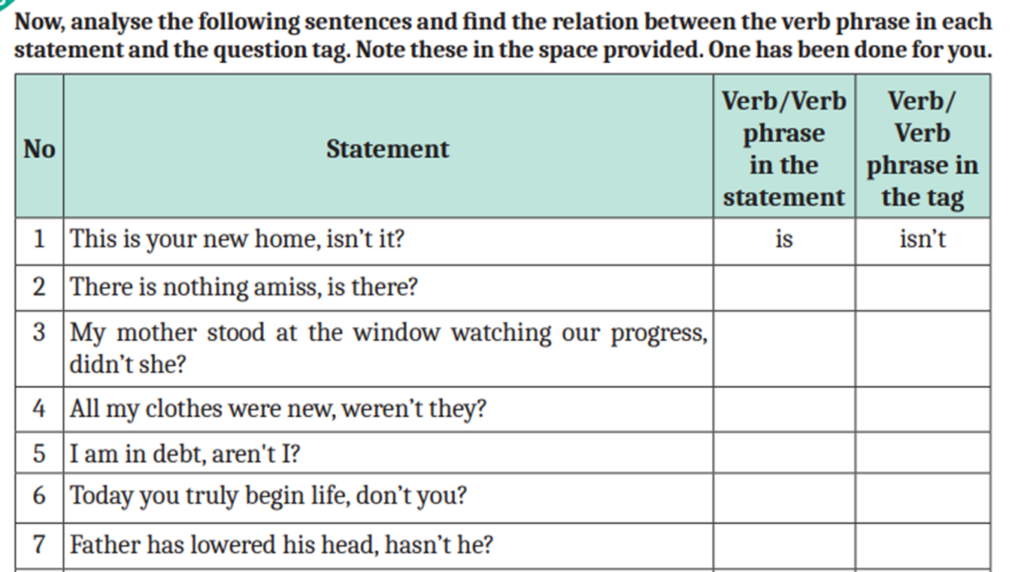
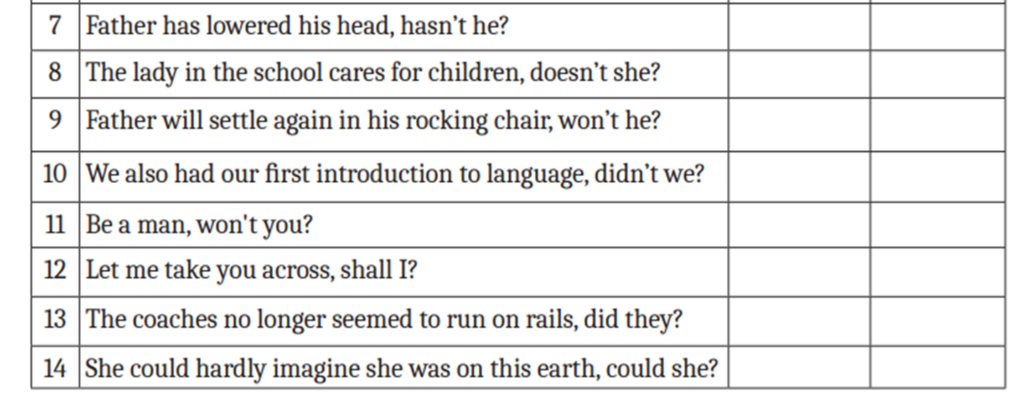
Read the following sentences from the story Half a Day.
I am not punishing you, am I?
Put a smile on your face, won’t you?
Why do you think the speaker added these short questions at the end of the sentences above?
Answers
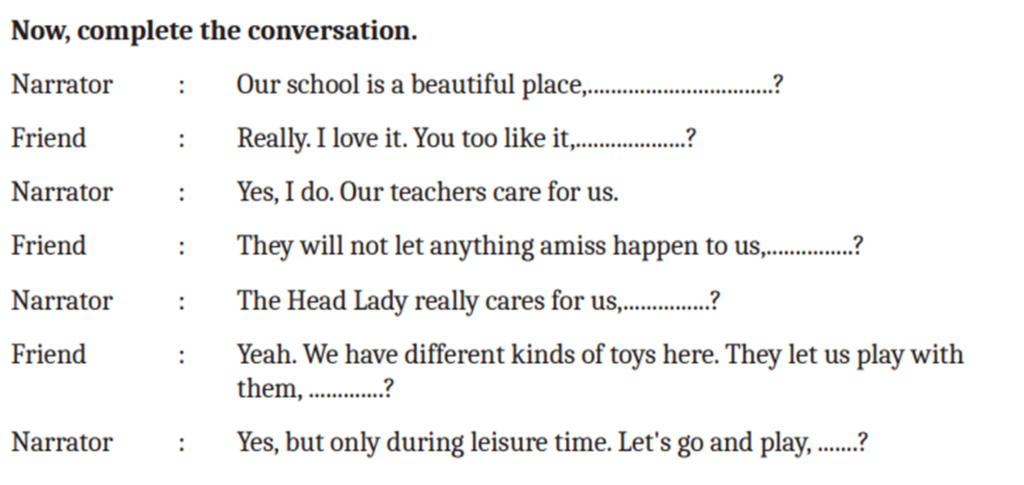
Our school is a beautiful place, isn’t it?
You too like it, don’t you?
They will not let anything amiss happen to us, will they?
The Head Lady really cares for us, doesn’t she?
They let us play with them, don’t they?
Let’s go and play, shall we?
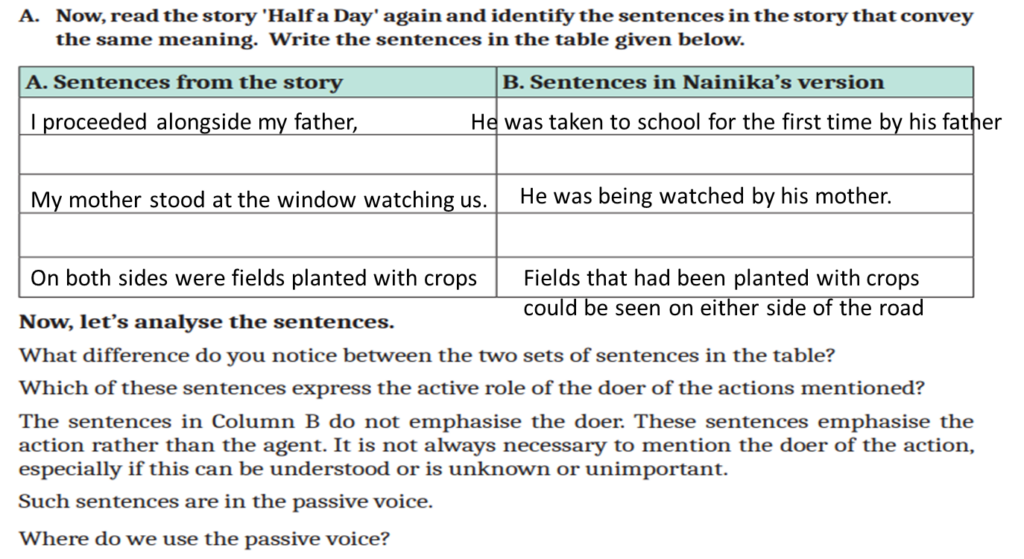
Match the sentences in the passive voice to the corresponding situation.
| Sentences in passive voice | Situations where passive voice is used |
| Women’s Reservation Bill was passed by the Lok Sabha | Reporting an event |
| The decision to conduct the tour was taken by the Head Mistress | Official announcement |
| The software was installed on the computer. | Technical documentation |
| The patient was examined by a team of doctors. | Healthcare and medical reports |
| The contract was signed by both parties | Legal document |
| The order was accepted by the vendor | Business correspondence |
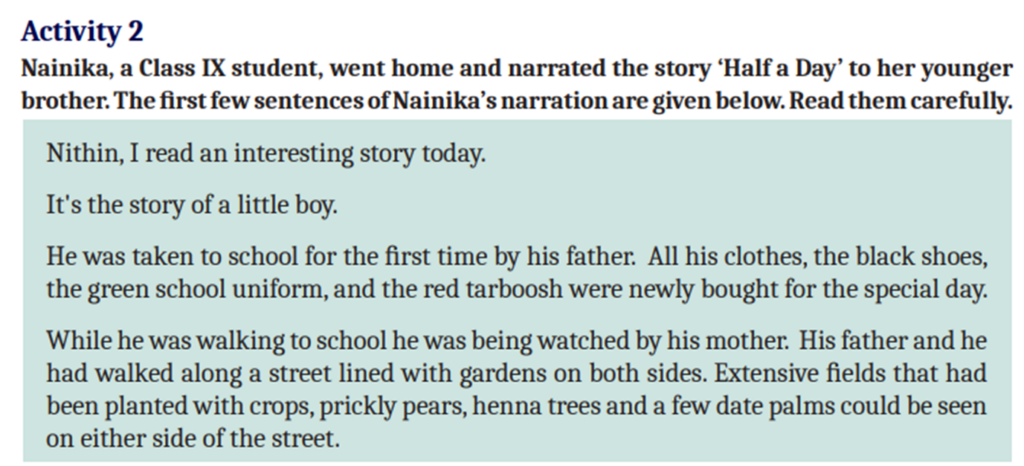
C. A few statements based on the story Half a Day are given below. Analyse them and note the change in the form of the verb.
| Sentences in active voice | Sentences in passive voice | Verb / verb phrase in active voice | Verb / verb phrase in passive voice |
| I challenged my father openly. | My father was openly challenged by me. | challenged | was challenged |
| He is throwing me into this building. | I am being thrown into this building. | is throwing | am being thrown |
| Father was tearing me away from my home. | I was being torn away from my home | was tearing | was being torn |
| The men were sorting us. | We were being sorted by the men. | were sorting | were being sorted |
| He has played all sorts of games. | All sorts of games have been played by him. | has played | have been played |
| We have chanted our first song. | Our first song has been chanted by us. | have chanted | has been chanted |
| They had introduced language to us. | Language had been introduced to us. | had introduced | had been introduced |
| I shall not annoy you. | You shall not be annoyed by me. | shall not annoy | shall not be annoyed |
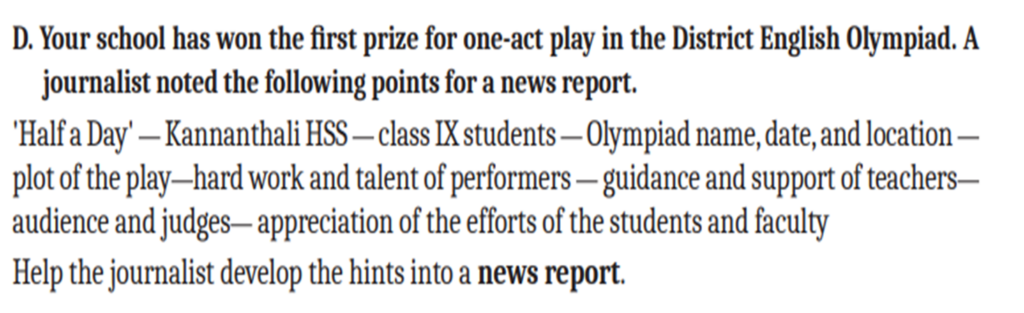
Sample report
Class IX students of Kannanthali HSS staged a one-act play based on the short story Half a Day at the District English Olympiad organized at Pattambi GVHS on July 16, 2026. The play depicted the life journey of a person from childhood to old age. It was a stark reminder of how quickly time flies. The acting, direction and screenplay were all good and it was evident that the teachers had given ample support and guidance to the students. No wonder, not only the audience but also the judges were impressed and they all appreciated the effort put in by both teachers and the students.
Activity 4
A. Look at the following sentences and underline the Noun Phrases in the subject position. One has been done for you.
Every sentence consists of a Noun Phrase and a Verb Phrase. Examples are given below.
All rustle and bustle (Noun phrase) ceased (verb phrase)
The coaches (noun phrase) glide into space (verb phrase)
My father (noun phrase) felt a deep sorrow (verb phrase)
B. Now, mark the noun phrases and the verb phrases in each of he following sentences
The sound of the wheels (noun phrase) becomes a soothing, peaceful melody (verb phrase).
Father (noun phrase) will straighten up in his rocking chair (verb phrase).
I (noun phrase) was coming to receive the Nobel Prize in Literature (verb phrase)
The coaches (noun phrase) no longer run on rails and sleepers (verb phrase).
My fellow passengers (noun phrase) were dozing in their respective corners (verb phrase).
I (noun phrase) was listening to the rattling of the train (verb phrase).
Activity 2
Underline the adjectives in the following sentences.
Imagine those pitiful, penniless wanderers who once roamed the expanse of Varmland in your youthful days, embracing their carefree, playful pranks and melodious tunes. How much I owe to them – all the laughter, the playfulness, the craziness – they painted my youth with vivid hues.
Compound adjectives
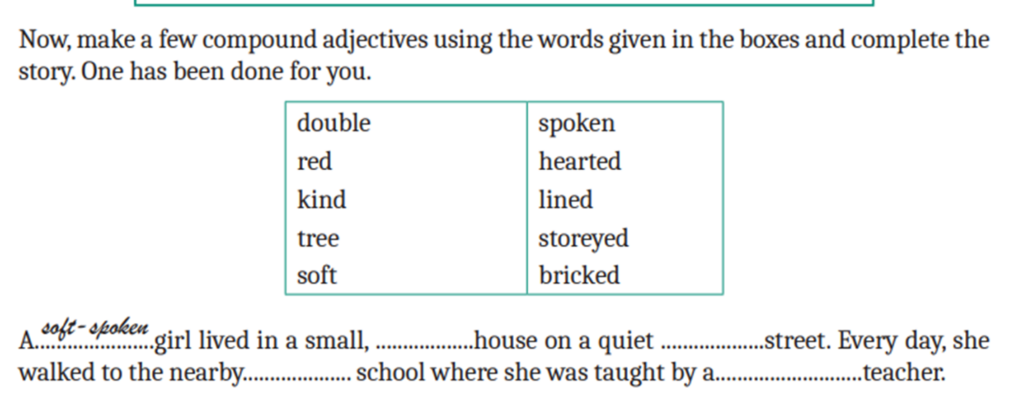
A soft-spoken girl lived in a small red-bricked house on a quiet tree-lined street. Every day, she walked to the nearby double-storeyed school where she was taught by a kind-hearted teacher.
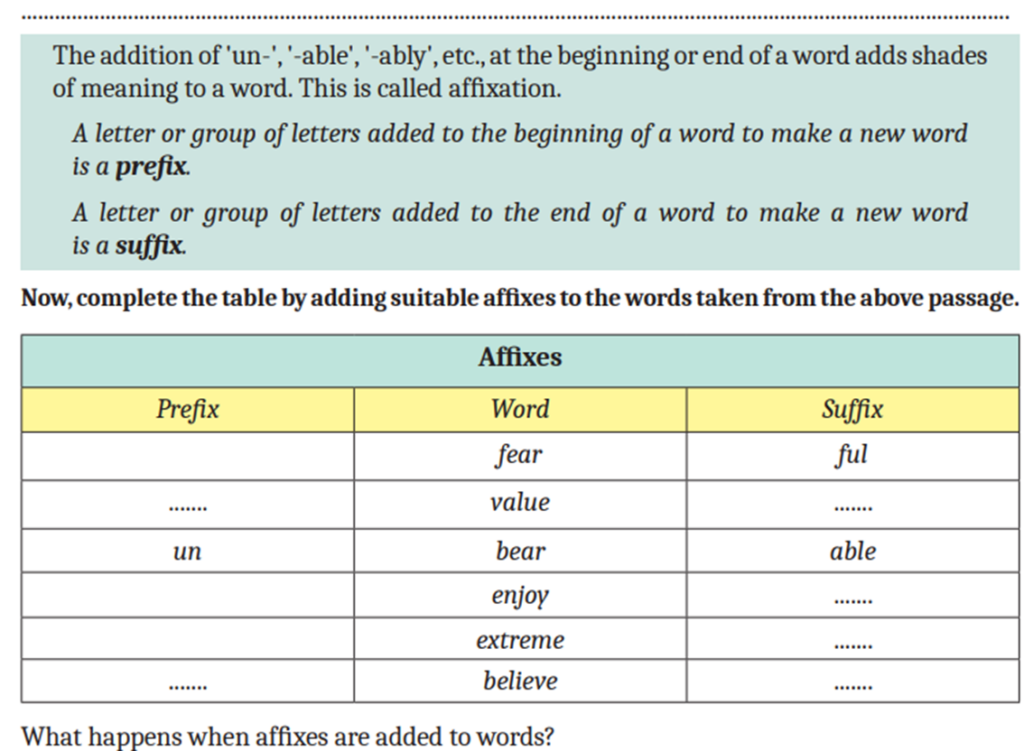
Answers
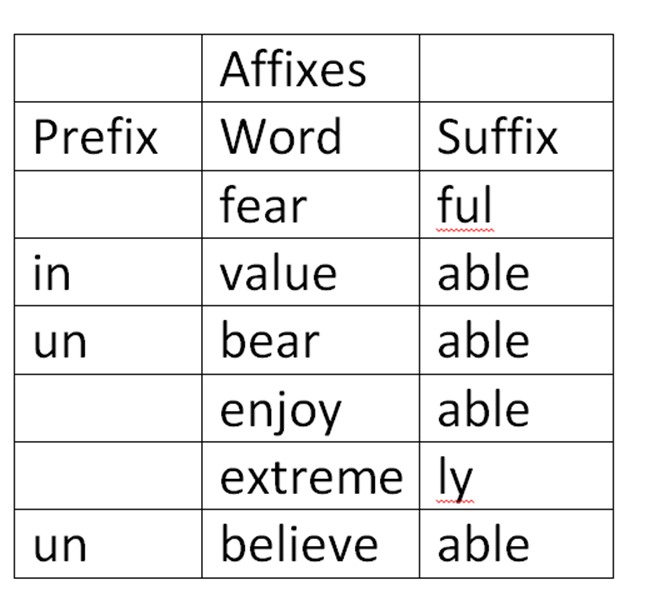
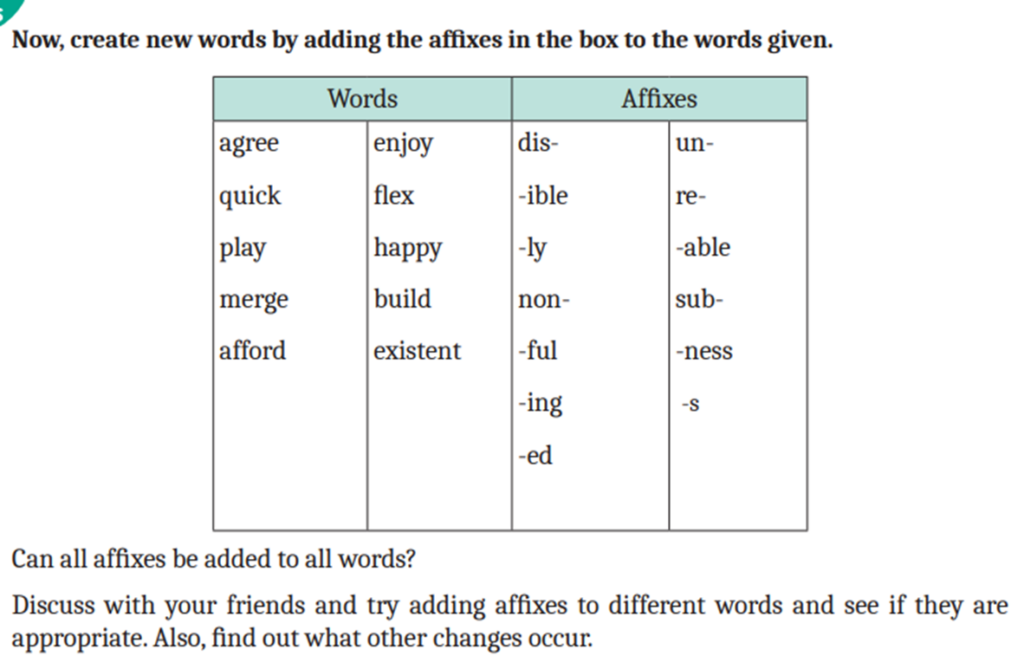
agree – agreeing, agrees, agreed, disagree, agreeable
quick – quickly
play – playful, plays, playing, played
merge – merging, merged, merges, submerge
afford – affordable, affording, affords, afforded,
enjoy – enjoyable, enjoys, enjoying, enjoyed
flex – flexible, flexes, flexing, flexed
happy – happiness, unhappy, happily
build – builds, building
existent – non-existent
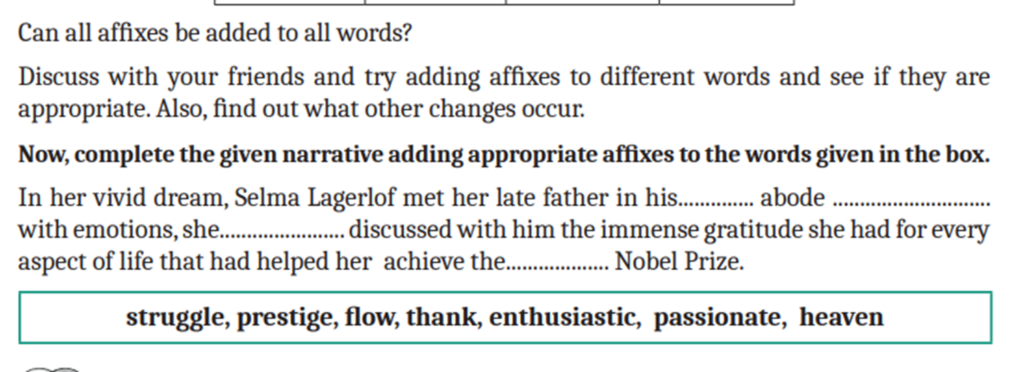
In her vivid dream, Selma Lagerlof met her late father in his heavenly abode struggling with emotions, she passionately discussed with him the immense gratitude she had for every aspect of her life that had helped her achieve the prestigious Nobel Prize.